Tuesday, December 20, 2016

Reflections on Christmas: Wise Men Still Seek Him

In my nativity set, I have camels, presumably to carry the wise men to Bethehem. We occasionally saw camels in Israel, but it was in Jordan that I had the chance to ride a camel.  It was great fun and I have new respect for the Wise Men.

We did not hear about Wise Men  while in Bethlehem though the scriptures testify that they visited the baby Jesus.  The wise men did not really kneel at the manger as we often imagine.  They came much later, perhaps as much as two years later.  We know this because Herod on learning that he had been tricked by the wise men ordered the death of all babies two years and younger.

Even though we know this, we celebrate the coming of the Wise Men when we celebrate Christmas.  We display them in our nativity sets and we include them in our singing of carols and in our  Christmas pageants 


The wise men, or Magi, came from afar, and unlike the  common, humble shepherds were men of wealth, influence, and power,  perhaps even kings.  And so we see that the Savior did not come to just one nation or class of people.

The Savior’s mission was to all people, rich and poor, learned and ignorant, humble and influential, Jew and gentile.   All men, no matter what their race or station can come to the Savior and become whole.  We are reminded that when he comes again every knee will bow and every tongue confess that Jesus is the Christ.

We feel a sense of wonder as we imagine the Wise Men opening their treasures for the small Jesus.  Their gifts were so well chosen.   Gold, a gift reserved for royalty, a gift representing a crown, a gift befitting a king. Frankincense, a type of incense used by the priests in the temple.  This was given as a symbol of his priesthood, his divine power, his Priestly nature.  Frankincense was used in the temple for sacrificial offerings, and was given to the baby Jesus... Jesus, who would one day teach us much about sacrifice...Jesus, who had come to sacrifice himself for us, that we might live again.  The third gift, myrhh, was a type of perfume used for burial, a gentle reminder that Jesus would one day die for us.

Don't you love these images:  Learned men searching for Jesus, the source of truth and knowledge; Influential men traveling through the darkness, to find the light of the world--following the star to seek the bright and morning star; perhaps even Kings, bowing before the King of Kings. 

Wise men still seek Him.

Monday, December 19, 2016

Reflections on Christmas: Shepherds

Oh how I wanted to see the Shepherd's Fields.

 The idea of shepherds has so much significance to me. I am touched by the thought that humble shepherds were the first to hear that Jesus had been born.  It delights me to know that God loves ordinary people doing ordinary work.  I am one of those ordinary people, and I love knowing that I matter to him.

Despite this symbolism, I believe that these shepherds were far from ordinary, for they tended temple sheep.  These sheep were sacrificial lambs who would be used in temple sacrifice, just as Jesus was the sacrificial lamb who would sacrifice His life for the sins of His people.

The symbolism is flawless.  Jesus is the Lamb of God and the Good Shepherd.  The angels sent these humble shepherds to worship the Lamb of God.  Perhaps they brought a lamb or two as a gift for the new born shepherd-king.

As it turns out the Shepherds Fields are now covered with houses in modern Bethlehem.  We happened to see a shepherd in Jerusalem near the Mount of Olives.

We were never close to any shepherds in Israel. It is my hope to draw ever closer to the one true shepherd of my heart--Jesus the Christ.


Sunday, December 18, 2016

Reflections on Christmas: Bethlehem


I was warned that Bethlehem would be different from the Bethlehem of my childhood stories.  I grew up imagining a wooden stable like the ones I had seen on the farm where I grew up.  The stable in my mind was very like the barn on my dad’s farm.  Only smaller.

Eventually I learned that the stable was more of a cave or grotto.  Even though I know this, I display a small wooden stable each Christmas with my small Mary and Joseph, hand painted by my talented daughter-in-law.

Was I warned that the stable would be small and crowded?  Or that the religious atmosphere might be somewhat foreign to me?  I don’t remember.  Perhaps I was.

We had been in Israel several days before we visited Bethlehem, and I had already learned that where ever a sacred site had been identified someone had built a church over the site or at least in close proximity.  Because of that the church built over the stable-cave was not a complete surprise.

The church was being remodeled and so there was scaffolding and other signs of construction.  There were candles and many electric lights and chandeliers, none of which seemed to match.  If there was significance to the randomness of the lights, no one mentioned it. Perhaps the lights were meant to honor the holy infant who was to be the Light of the World.

It was crowded and there was a line to see the place where Jesus was born.  We were told that this was a short line.  We felt a bit rushed because of the people behind us and the small space inside the cave.

We hastily glanced around us, touched the gold star on the floor where they said the baby had been born, and wished we could see the manger, which is now in Rome.  We wondered if there had been room for animals and shepherds in this tiny place.

I wrote this poem shortly after our visit to Bethlehem.


In Search of the Stable

Is this cave the stable in Luke’s story,
The place where you were born?
I touched the star where they said it happened

And snapped a photo in your honor
Of the place they say you slept.
The manger is in Rome not here.
This is not the way I pictured it.

I have a different picture of this place
In the manger of my heart
and the stable of my mind.
I like my picture better,
But I am glad to be here anyway
And wish you a happy unbirthday
In October instead of April, or December


Sunday, October 16, 2016

Nazareth Part 2

The inner door is for people to enter.  The larger door is for animals.


A depiction of the Synagogue in Nazareth.

Scrolls like those that would have been used in a synagogue.
Synagogue Windows
Tools that a carpenter may have used in Nazareth.

more tools

A typical shepherd of the day.

Galilee


Our hotel was next to the Sea of Galilee with a beautiful view both morning and night.  During the day we were able to travel to many spots with historical and scriptural significance.  The scriptural stories that I learned in my youth took on new significance as I stood on sacred ground near the spots where those stories took place.  I had a testimony before I went to Israel, but I am changed somehow.  I have a better understanding of the culture.  I have a better understanding of Jesus and His gospel.  I appreciate Him more.  I want to know Him better.


Our first stop was Mount Arbel where we had a gorgeous view of the Galilee.  The Galilee refers to the entire region surrounding the sea of Galilee.  

It was a bit of a hike.


Mount Arabel was historically a pretty bloody place.  There are caves in the cliff where more than once Jews hid themselves from conquering rulers.  It never ended well.  Most who sought refuge in the caves were brutally killed.  Other jumped from the mount to avoid becoming slaves.


Look at this stunning mosaic.  

Nazareth

Jesus grew up in Nazareth.  He probably learned to be a carpenter from Joseph. He knew the village and surrounding hillside.  He played with other children and learned the culture of the Jews.

He also learned about His mission and destiny.  Who were His teachers?

Eventually He preached here and announced in the synagogue that He was the Messiah, but the people of Nazareth rejected Him.  A prophet is not without honor except in his own country.

This is also the place that Nephi saw in vision when the angel revealed Mary the mother of Jesus to him.  This is the place where Gabriel told Mary she would be the mother of the Son of God.  This is the place where Gabriel visited Joseph and told him to take Mary to be his wife and the name her son Jesus.


We visited a reconstructed village in Nazareth which depicted Jesus's childhood home.
.


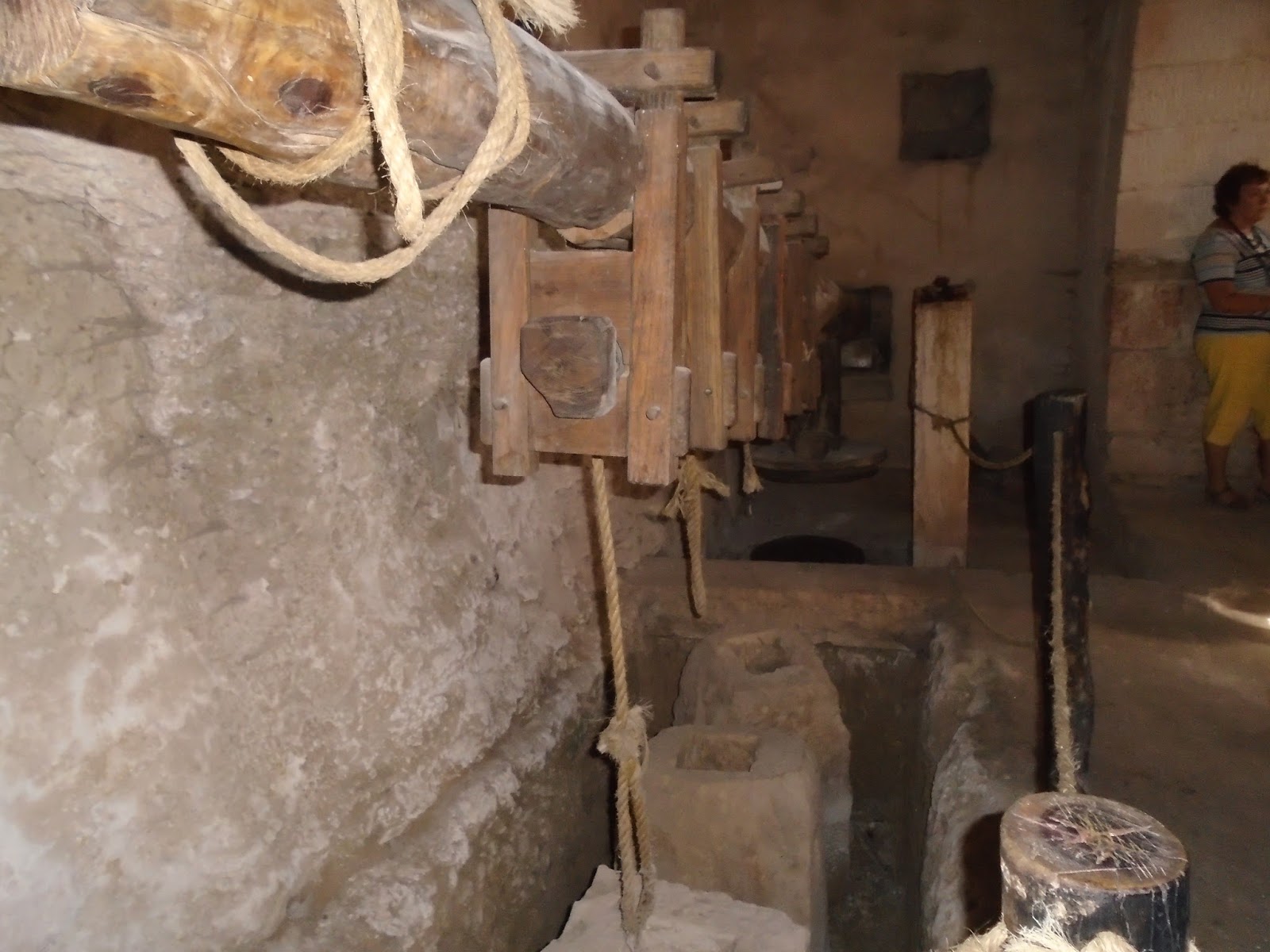
We saw our first olive press here.  The olives are hung in bags and weighted to extract the first oil.  This is the prized virgin olive oil


In this type of press the olives are pitted and then crushed.  This releases more oil.  Oil is 50 % or more of the weight of the olives.


An olive garden, early tools from the period, traditional weaving and a shepherd, are some of the things we saw here.  Local Christians volunteer to be actors at this sight to make the experience more real.


This is how the olives look on the tree.


The woman who was weaving was animated and joyful.  Someone mentioned to her that she could get rich selling her rugs and mats. She did a little dance and said, "I am already rich, because I am the daughter of the King of Kings."


For some reason I was a little surprised to find Christians in Israel who openly displayed their love for Jesus Christ.  I asked how many Christians live in Israel.  Our guide estimated that there are around 160,000 or less than 5% of the population.


A noisy donkey.  Donkeys were a common way of transporting people and goods in Nazareth.  Especially for the poor.
A wine press.  Many families made their own olive oil and their own wine..  They used their feet to mash the grapes so that they would not crush the seeds which would make the wine bitter.  There was a channel cut in the ground to carry the wine to a vat where it could be put into bottles.

Thursday, February 4, 2016

Why China? Part 5: Pandas

Pandas are an endangered species, native to China.  There are only about 2000 in the world and only about 49 live outside of China.  About 239 Pandas are in captivity in China and the rest live in natural habitat. 

The 49 or so Panda living outside of China are in 18 different zoos in 13 different countries.  China once gave two pandas to the United States as a gift.  Their new address was the Washington D.C. zoo.  China gave 23 Pandas to 9 different countries between 1958 and 1982 as an act of diplomacy. 

In 1984, the Chinese stopped giving Pandas as gifts and now they only loan Pandas for ten years.  The loan comes with a price tag of $10,000 to $1,000,000 per year.  Some of that money goes to conservation of Panda habitat and research.  Any offspring born to Pandas on loan also belong to
China.

The name Panda means Big Bear Cat.  Pandas are scientifically classified as meat-eaters because of their digestive system, but live almost entirely on bamboo.   Adult Pandas eat an astonishing 20 to 30 pounds of bamboo each day. It takes a lot of time to get all that bamboo down.  They spend about 12 hours of every day eating.  That's right, 12 hours out of every 24 hours is spent in the dining room.

Pandas sometimes eat small birds and rodents.

An adult male can weigh as much as 350 pounds.  Females are smaller and can weigh anywhere from 150 to 275 pounds.   Baby Pandas are tiny, weighing less than 5 ounces .  Imagine a rounded cube of butter and you've got the idea, except that the butter is pink. Panda cubs are born blind, pink, and with no teeth.
In a few week the cub's skin turns gray in spots, the spots that will eventually become black.  The color pattern is set after about a month.  The first fur is very soft and coarsens over time.

Panda cubs crawl at around 3 months and start snacking on bamboo when they are 6 months old.  They depend mostly on their Mother’s milk for the first year.  On their first birthday, panda cubs weigh about 100 pounds.  They will live with their mother for up to two years.  In the wild, a mother Panda gives birth about once every two years.  Panda dads don’t stick around to help raise the kids.

Pandas don’t reproduce much in captivity. Apparently Pandas are shy about mating in public.  Panda
keepers have tried Viagra and Panda porn, but the most success has come from artificial insemination. 

Six Pandas live in the Beijing Zoo.  We were hoping to see at least one of them.  Our guide told us that on a good day we might see two or three.  To our delight we saw all six of the handsome creatures.  For some of us it was a first.

Six out of six.  I guess it was a good day. 

Linda Garner